DiffButler
A terminal dashboard for human-directed AI code reviews on GitHub.
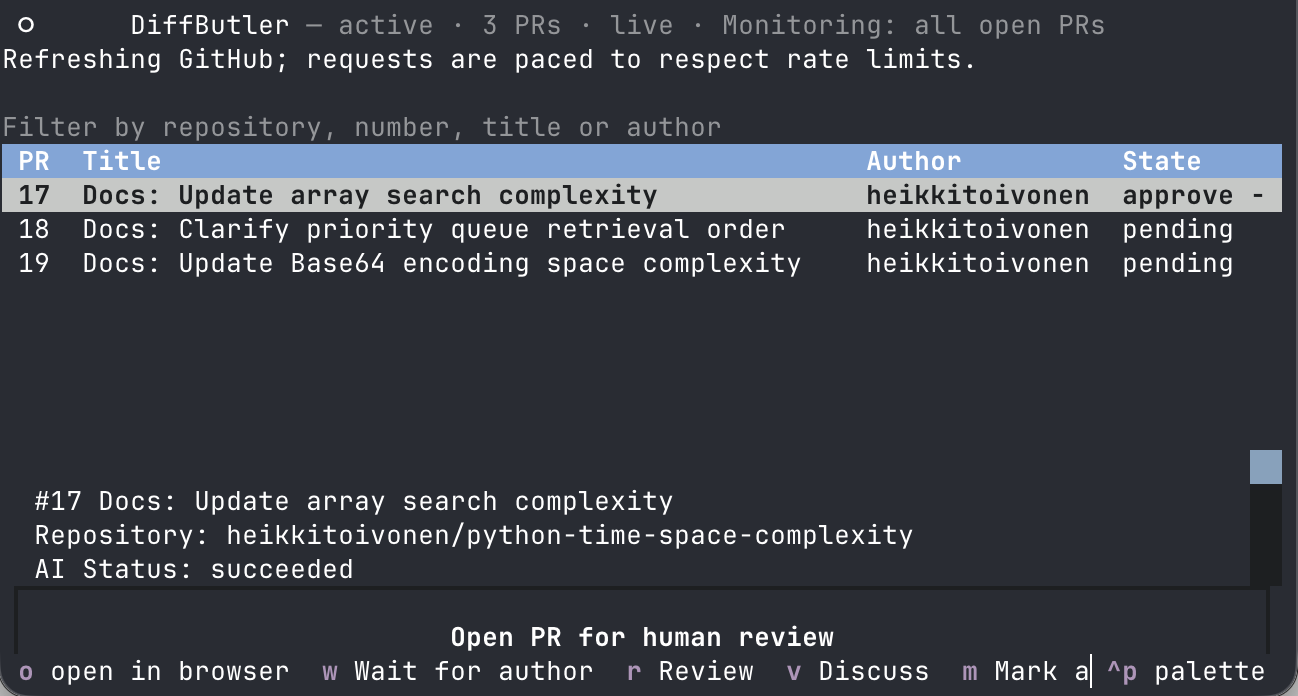
Keep track of what each pull request needs next: AI review, your review, or author changes. Start an AI review, discuss its findings in the agent's own session, and finish your review in the browser.
Install
Install uv and Git, then install DiffButler from PyPI:
uv tool install --python 3.14 diffbutler
uv manages Python and dependencies in an isolated environment. No virtual environment
activation is needed. If diffbutler is not on your PATH, run uv tool update-shell
and restart your shell.
To upgrade a PyPI installation:
uv tool upgrade diffbutler
To install from a local checkout of this repository instead, run from its root:
uv tool install --python 3.14 .
Install and sign in to Codex CLI or Claude Code before requesting AI reviews. The native presets support Codex CLI or Claude Code on Linux and macOS without version checks. Reviews use your normal agent settings, including model and reasoning effort, with background permission and output overrides. New conversations remain in the agent’s own history after DiffButler cleans up its workspaces; existing private sessions retain their original home for resume. See supported agents and validation for details.
Use
Use authenticated GitHub access, including for public repositories. If you already
use gh auth login, export its token before launching DiffButler:
export GITHUB_TOKEN="$(gh auth token)"
Alternatively, create a fine-grained personal access token
for the repositories you want to review with Pull requests: Read-only permission,
and set it as GITHUB_TOKEN. Anonymous access is a last resort for public repositories;
its low API quota makes it unsuitable for regular polling. See the
authentication guide for host/account selection,
HTTPS versus SSH Git setup, and token permissions.
From the GitHub repository you want to review, launch:
diffbutler
First-run setup detects the local repository, looks up your GitHub username using
the selected token, asks for your preferred agent, and saves your choices. If username detection
is unavailable, setup asks for it. Choose the recommended token access for public repositories;
private repositories require it. Setup asks for the token's environment variable name
and validates access. It never saves the token.
New configs silently enable both Codex and Claude when found in PATH; setup asks
only which detected agent should be the default. Missing agents get commented-out
entries you can enable after installation.
Later launches reuse your configuration.
The dashboard shows active reviews, including followed PRs whose GitHub review
requests have disappeared after you posted feedback. Waiting-for-author reviews
stay visible across refreshes and restarts. If an approved PR receives new commits,
it reappears as done+ at the end of the queue without starting another AI review.
Authenticated polling slows when API quota is scarce and speeds back up when it
recovers, accounting for refresh cost and time until the quota resets.
Select a PR with the arrow keys, then work through the review:
- Optionally press
nto change the current configured AI reviewer for all PRs. Pressrto start a background AI review. Reviews start only when you request them. The agent is instructed to read the PR description, discussion, and earlier review threads and replies before reviewing the local code, reporting any unavailable context. DiffButler caches full Git history and reviews changes from the PR merge base to its head, excluding unrelated changes made later on the target branch. - A successful review shows
approveonly when the AI explicitly reports no findings; otherwise it showscheck. PressEnterto read the results, orcto resume the saved agent conversation. If the agent exits normally but DiffButler cannot parse its output, the task also showscheck; usecto inspect the saved conversation orLfor captured output. Changing reviewers leaves that conversation available throughc; pressingrstarts a new run with the current reviewer and replaces the current review details. Ask questions and explicitly tell the agent which comments to post, if any. - Exit the agent to return to the dashboard, which refreshes activity from GitHub.
Press
wif you are waiting for author changes, oroto review in your browser. - After approving on GitHub, press
mto mark the task complete locally. DiffButler also detects your approval, closure, or merge and cleans up owned session resources while retaining review history.
Space performs the selected PR's next action: start a review, discuss findings,
or open the browser. An AI review never counts as your approval. Background analysis
uses the agent's native permission controls
and read-only review instructions; source sent to the agent may go to its model provider.
/: Filter the queue.a: Toggle monitoring all open PRs in configured repositories.b: Browse accessible PRs and follow one.R: Refresh from GitHub.k: Stop the selected PR's review and reset its local tracking and owned resources. It disappears until a forge refresh rediscovers it; review history is retained.h: View completed review history.?: Show all keyboard shortcuts.q: Quit.
See the dashboard guide for all actions and configuration guide for settings.
Your own PRs are hidden from the review queue by default, including direct and team
requests. Set include_own_prs = true in [ui] to review them, such as PRs an agent
created using your account. PRs assigned to you are also hidden by default, even when
you are requested directly or through a team. Set include_assigned_prs = true in
[ui] to include them.
Reset
Close running DiffButler sessions, then run:
diffbutler reset
DiffButler refuses a second command or dashboard using the same data home, including
reset, while another instance is running. Its instance lock releases on process
exit; a leftover PID file does not block startup. See the
locking details before handling Git lock files
or resetting after a crash.
After confirmation, this permanently removes DiffButler's standard configuration,
data, and state directories, including review history, saved sessions, and diagnostic
logs. Custom files outside those directories are preserved. Use diffbutler reset --force
to skip confirmation. Run diffbutler again to repeat first-run setup.
Uninstall
Remove the uv-installed command and its isolated environment:
uv tool uninstall diffbutler
This keeps your DiffButler configuration, review history, and diagnostic logs.
To remove those too, run diffbutler reset before uninstalling; see
Reset for what it deletes.
Contributing
See CONTRIBUTING.md for development setup and checks.
License
MIT.